The last dinner I had with my parents must have been ordinary. My mother sent me home with chicken soup, my father complained about the price of butter, and I promised I’d come back the following weekend, as if promises could stop time.
My parents had lived in that house for 32 years. They knew every creak of the floorboards, every cold spot near the windows, every stubborn habit of the basement door. It was where Kara and I learned to ride bikes.
Kara was my older sister by three years, and for most of our lives she had been the organized one. She remembered birthdays, organized insurance paperwork, and knew where our parents kept appliance manuals and spare keys.
Image
Six months earlier, after Dad’s knee surgery, Mom asked Kara to help with the online bills. It was supposed to be temporary. Kara got the passwords, the mailbox key, and permission to speak to the repair companies on her behalf.
That was the sign of trust that none of us recognized at the time. My parents didn’t give Kara money. They gave her access, and access can become more dangerous than money when someone decides that kindness is weakness.
The message from Tuesday arrived at 5:18 pm. I still remember how it looked on my phone. “Can you stop by Mom and Dad’s house and pick up the mail? We’ll be away for a few days. Don’t forget the basement door gets stuck.”
I was busy enough to believe it and guilty enough not to question it. I bought grapes, butter, and sourdough bread because those were the things that made my mother smile and made my father pretend he wasn’t pleased.
By the time I arrived at their street, dusk had tinged the yards a grayish blue. The porch light was on. Mom’s little car was in the driveway. Dad’s pickup truck was tilted near the garage just the way he always parked it.
The house looked normal from the outside, which is the cruelest thing about some emergencies. There were no broken windows, no smoke coming from the roof, and no neighbors yelling from the yard that something had gone wrong.
Inside, the silence felt almost physical. The stale air pressed against my face, and the warm living room lamp made it all the worse, illuminating the scene softly, almost tenderly, as if nothing terrible had happened.
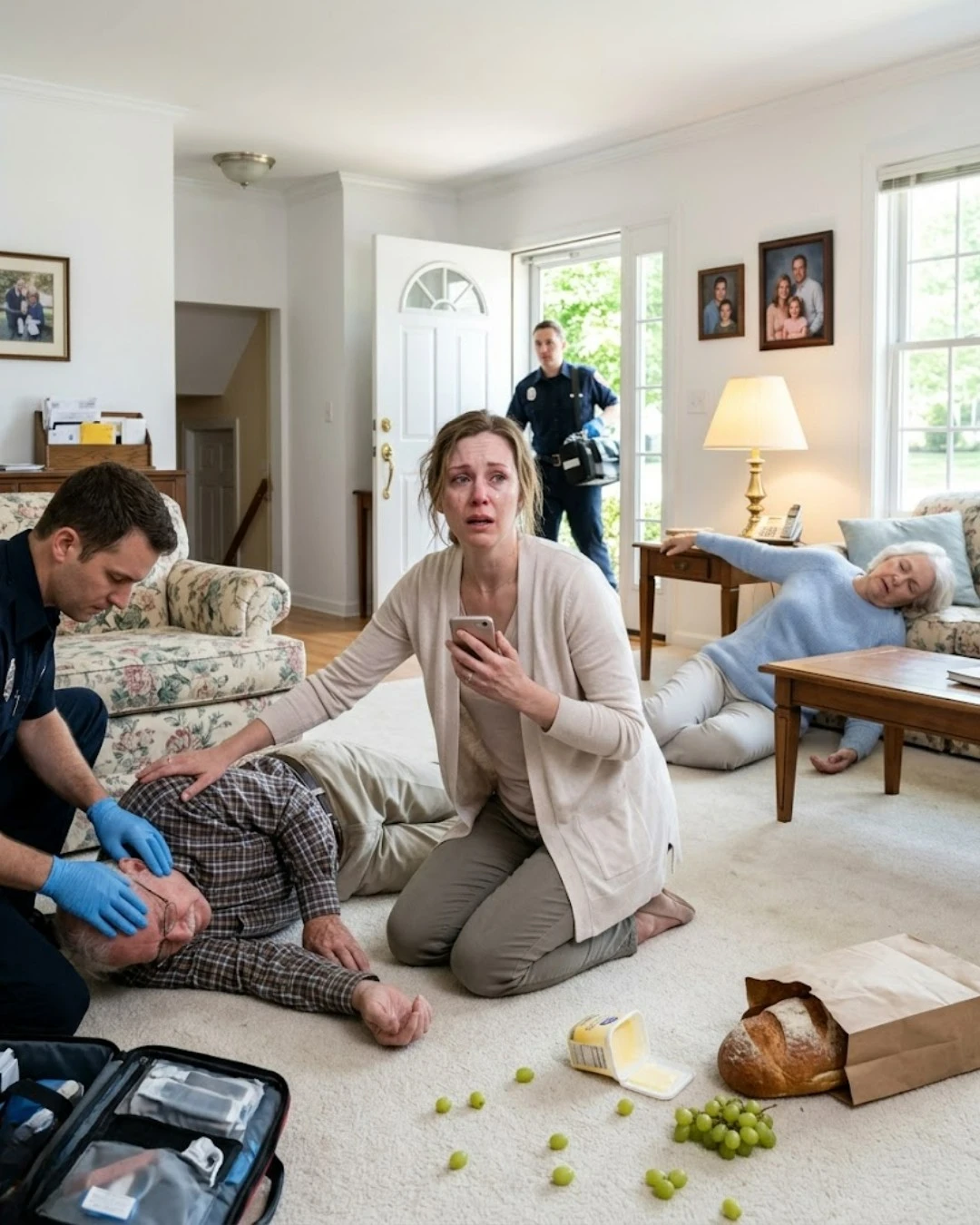
My mother was on the floor near the coffee table. My father was by the sofa, his glasses askew and his mouth slightly open. The grocery bag fell from my hand, and the grapes rolled under the console table.
I touched my mother’s cheek and felt that coldness I’ll never forget. Not the coldness of death, but the coldness of a body fighting from afar. Then I found Dad’s pulse, thin as a thread.
The 911 call began at 6:41 p.m., according to the North County Dispatch log. The dispatcher told me to count my breaths, open the front door, and stay out of any rooms that smelled strange or made me dizzy.
I remember looking at my mother’s outstretched hand toward the phone. I was close enough to know she’d tried. Maybe she’d tried to reach it when the room started tilting. Maybe Dad had fallen before he could help.
The paramedics moved with professional speed, but even they exchanged a glance as they entered. One asked for medications. Another asked for cleaning supplies. A third asked if the heating and water heater were in the basement.
At St. Agnes Regional, the initial ER admission form listed them as unconscious upon arrival. The toxicology panel came back marked as urgent, and the doctor led me to a hallway that smelled of disinfectant and burnt coffee.
She used a careful voice, the kind doctors use when they know a single word could tear a family apart. She said my parents had been poisoned by exposure inside the house, and that the moment I found them, I had probably saved their lives.
I kept asking if it had been an accident. The doctor wouldn’t answer that. He only said that the pattern was serious, that investigators would have to inspect the house, and that no one should enter the basement without authorization.
My husband arrived carrying my coat because I had left it on a plastic chair at the hospital. He read Kara’s message twice. Then he asked a question I had been too afraid to ask.
—Why would you say they were gone for a few days if both cars were there?
Kara arrived at the hospital that night wearing travel clothes, though we later learned that no boarding pass matched her story. She cried loudly in the waiting room, hugged me tightly, and kept asking if Mom had said anything.
There was a moment when everyone around us froze. My husband stopped scrolling. A nurse paused, holding a clipboard. Even Kara’s breath caught in her throat when she realized no one had answered her question. No one moved.
People think betrayal comes with shouts, but sometimes it comes disguised as a practical reminder. A phrase. A task. A door you were told to notice after danger was already waiting behind it.
For three days, Mom and Dad drifted between sleep and confusion. Mom woke first, whispering that she wanted water and then asking why the television was off. Dad woke next, furious because someone had cut his shirt.
They remembered feeling tired. They remembered the detector beeping and then stopping. They remembered Kara calling Monday afternoon and telling them not to worry about the service appointment because she had already “taken care of it.” That single sentence changed the room.
My husband didn’t accuse anyone in front of them. He waited until they were stable, gathered the 911 incident report, requested a copy of the toxicology report, and printed my screenshot of Kara’s message.
On the seventh day, he took me back to the house. We didn’t enter as owners. We entered as people entering an evidence scene. He photographed the front door, the coffee table, and the path to the basement.
The basement door wasn’t sticking. That was the first thing he noticed. It opened smoothly until his thumb grazed the latch, where a pale scratch cut through years of darkened brass.
On the floor lay a torn corner of blue paper. I had stepped on it the night I found my parents, too blinded by terror to notice. My husband picked it up and stopped breathing for a second.
The paper matched a Harrigan Fuel & Heat service notice. The full notice was tucked behind a paint can near the heating room. It was dated Monday, included an emergency return number, and a handwritten cancellation line.
The line said the inspection had been canceled at the family’s request. Below it was a name and phone number. It was Kara’s.
My knees weakened so quickly that I had to hold onto the handrail. My husband didn’t fold anything, didn’t put anything in his pocket, he only touched the edges. He photographed the paper where it was and then called the detective assigned to the case.
What she discovered didn’t prove all the motives, but it did prove the lie. Kara had known about the service problem before she texted me. She had known my parents weren’t out. She had sent me there late.
The detective then found two more pieces of evidence. First, Harrigan Fuel & Heat had left a voicemail warning that the house needed immediate attention. Second, Kara had used access to our parents’ account to cancel the appointment and redirect follow-up notifications.
Kara’s explanation changed three times. She said she had misunderstood. She said her mother had asked her to cancel. Then she said her father never wanted strangers in the house and that she was protecting him from being overcharged.
Dad listened from his hospital bed with an oxygen cannula still under his nose and said:
—I never told you that.
His voice was weak, but the room heard him clearly.
Mom only cried once, and it wasn’t when the detective explained the evidence. She cried when she realized Kara had sent me to collect the mail from a house where she already knew something was wrong.
The legal process moved slowly. Investigators didn’t call it attempted murder at first, and I learned that real life is rarely as clean as people want it to be. Paperwork drags on. Evidence matters. Intent is hard to define.
But the documents constructed their own kind of voice. The 911 log, the hospital toxicology panel, the service notice, the phone records, the canceled appointment, and the redirected mail all pointed toward the same impossible truth.
Kara ultimately pleaded guilty to charges related to reckless endangerment and obstruction. The court also prohibited her from managing our parents’ accounts, entering their property, or contacting them without written approval.
The verdict didn’t feel like justice in the way movies promise it. There was no thunder. No dramatic breakdown. Just a judge reading terms while my mother squeezed my father’s hand so hard her knuckles turned white.
My parents survived, but surviving isn’t the same as coming back unscathed. Dad now checks every alarm battery on the first day of every month. Mom turns the TV up louder than before, especially at night.
The house changed, too. The basement door was repaired. The heating system was replaced. Every utility bill now sends notices to three different email addresses, including mine and my husband’s, because trust sometimes needs to become a system.
Kara has written letters. My parents haven’t responded. I don’t know if they ever will, and I’ve stopped pretending that forgiveness is something outsiders can program for people who have been hurt.
What I remember most is still that first moment at the entrance. I went home smiling to surprise my parents, and I found the two people who raised me motionless under a soft, yellow lamp.
For weeks, I hated myself for not visiting them sooner. My husband kept telling me I’d arrived on time, but guilt doesn’t obey facts quickly. It sits beside you until the evidence slowly teaches it to move.
Now, when I think about that night, I don’t just see fear. I see my mother’s hand reaching for the phone. I see my father’s pulse beneath my fingers. I see a daughter finally listening to the silence.
People think betrayal comes with shouting, but sometimes it comes disguised as a practical reminder. That phrase has never left me, because an ordinary message almost became the last message our family ever trusted again.