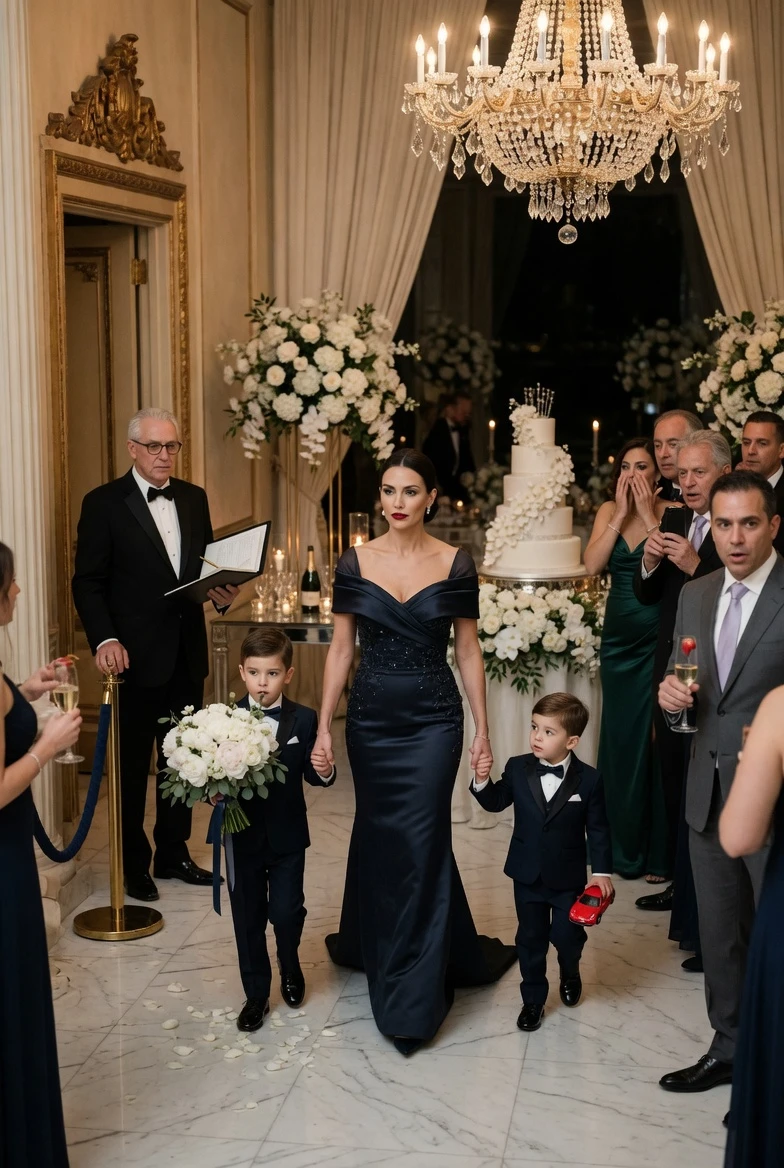
—Roman, maybe not now.
“What now?” Roman smiled wider. “Marina came. The children came. Everything is fine.”
Everything’s fine.
The phrase of cowards.
The phrase Roman used when the house was falling apart and he didn’t want me to look at the cracks.
I breathed.
Once.
Two.
I felt Misha’s hand on my coat.
“Mom, let’s go,” she whispered.
And that was the moment.
Not the one with the papers.
Not Roman’s.
Not the wedding one.
Mine.
Because I could protect my children by getting them out of there.
Or I could protect them by showing them the truth.
And neither option was clean.
If I left, they would remember the laughter.
If I stayed, they would remember the scandal.
I knelt in front of them.
I didn’t care about the dress.
I didn’t care about the people watching.
—Misha, Matvey, listen to me carefully— I said slowly. —You didn’t do anything wrong.
Matvey’s eyes were bright.
Misha clenched his teeth like children do when they try not to cry.
—Whatever happens now, it’s not your fault.
Roman let out a dry laugh.
—What a show.
I got up.
And I took out the folder.
Not as a threat.
Not with anger.
I placed it on the nearest table, next to an untouched glass of champagne.
—Roman, I need to ask you a question.
He looked at the folder.
For the first time that night, her face truly changed.
Not much.
Just a blink that was too slow.
-What’s that?
—Documents.
—What documents are you talking about?
—From the house.
The word fell like a plate to the floor.
Tamara paled.
Alina placed her hand on her stomach, but her fingers closed.
Roman looked at Eduard.
That’s where he made his first mistake.
Because nobody else knew who Eduard was yet.
But everyone saw that Roman did recognize him.
“You?” said Roman, almost voiceless.
Eduard bowed his head.
-Good night.
Roman swallowed hard.
He did it quickly.
But I saw it.
I had spent too many years interpreting his silence.
—Marina —he said—, you have no idea what you’re getting yourself into.
“Probably not,” I replied. “That’s why I’m going to ask in front of everyone.”
A murmur rippled through the room.
The bride, poor girl, stood by the dessert table, stiff and confused.
I felt sorry for her.
Also by Ilya.
But then I remembered that no one felt sorry when Roman invited me to be exhibited as a warning.
“Did I sign this power of attorney?” I asked, holding up a copy.
Roman smiled.
Too late.
-Of course.
-When?
—Marina, please.
-When?
His mother took a step closer.
—You have no shame. Coming to a wedding with dirty papers.
I looked at her.
—I felt ashamed for two years. Today I brought questions.
Eduard took out his phone.
He didn’t pick it up.
He just held it in his hand.
—Mr. Roman, it’s best to answer carefully.
Roman glared at him.
—You have no right to intervene.
—I have the right to be heard when my company appears in a dubious transfer.
The room started moving again.
Not with noise.
With breaths.
With chairs barely dragged.
With people leaning towards the table.
Roman approached me.
He lowered his voice.
—Put that away now and I promise we’ll talk tomorrow.
There it was.
The real Roman.
Not the smiling father.
Not the successful man.
The man who negotiated when he could no longer give orders.
—No —I said.
It was a small word.
But he held me together.
—Marina, don’t be stupid.
Misha stepped forward.
—Don’t tell my mom that.
Roman looked at his son.
And for a second I saw something almost human in his face.
No love.
No regrets.
Perhaps a surprise.
As if he had just discovered that a child could also remember everything.
—Misha, come here —he ordered.
My son didn’t move.
Matvey stuck to my leg.
Alina got up slowly.
—Roman, what’s going on?
He didn’t look at her.
That was his second mistake.
Because she did notice it.
“Nothing,” he said. “My ex-wife wants to ruin a wedding.”
“No,” I said. “Your ex-wife wants to know if you forged her signature to sell her children’s house.”
The word “you counterfeited” changed the atmosphere.
It was no longer an awkward scene.
It was something dangerous.
Something that no one could pretend they hadn’t heard.
Tamara murmured:
—Be careful what you say.
—I’ve been careful for years —I replied—. So careful that I almost disappeared.
I didn’t know he was going to say that.
She left alone.
And when it came out, it hurt.
Because it was true.
I had slowly disappeared.
First I stopped buying clothes.
Then I stopped responding when they humiliated me.
After that, I stopped telling people how I lived.
I finally stopped waiting for an apology.
Roman took the copy from my hand.
She read it quickly.
Then he tried to laugh.
—This proves nothing.
—There’s more.
I opened the folder.
I took out the deed.
The sales contract.
Money movements.
The company linked to Alina.
When I said her name, she backed away.
“Me?” he asked.
Her voice didn’t sound guilty.
She sounded scared.
I looked at her and understood that perhaps she didn’t know the whole truth either.
That was the unfair part.
I wanted to hate her.
It was easier.
But Alina looked like a woman who had just discovered that her future was built on a locked room.
“The company is registered in your brother’s name,” Eduard said calmly. “And he received a transfer after the sale.”
Roman clutched the documents.
—That’s a lie.
—Then it will be easy to clarify.
—Not at a wedding!
Her scream broke something.
The music stopped.
I don’t know who did it.
Maybe the DJ.
Perhaps silence itself defeated her.
The children were startled.
And right there, I almost left.
Because I saw Matvey covering his ears.
I saw Misha trying to be brave.
And I hated myself a little for bringing them.
I had wanted them to see that their mother was not weak.
But they didn’t need a heroine.
They needed a mother.
I kept the papers.
Roman exhaled, believing he had won.
“Finally,” he said.
I leaned towards my children.
—Let’s go outside for a moment.
Satisfaction returned to his face.
But I didn’t care anymore.
I took the children by the hand and walked towards the hallway.
Eduard followed me without asking.
Roman too.
“Don’t you dare leave with those papers,” he said.
I turned around.
—They are copies.
Her face closed.
—What did you do?
—What I should have done two years ago.
That wasn’t entirely true.
I hadn’t done anything yet.
It had only just begun.
But Roman didn’t know that.
And for the first time, he was the one imagining dangers.
In the hallway, away from the tables, Matvey began to cry.
Not strong.
Just with a twisted mouth and full eyes.
I picked it up.
Her body was warm.
Heavy.
Real.
Much more real than any document.
“I want to go home,” she whispered.
—I know, my love.
Misha wasn’t crying.
That worried me even more.
“Did Dad steal our house?” he asked.
I closed my eyes.
That was the question.
The real one.
Not the legal one.
Not the social one.
The one that no judge could have formulated better.
Roman appeared in the doorway of the hallway.
—Don’t involve the children in this.
I laughed.
I couldn’t help it.
A short, broken laugh.
-I?
—Yes, you. You came here with a stranger and a folder.
—You brought them in when you sold their room.
Roman remained still.
Misha raised his head.
—My blue room?
Nobody spoke.
Not even Roman.
Neither do I.
Because that room still existed in my son’s memory.
The stars stuck to the ceiling.
The small bed next to the window.
The crooked drawing that said “Mom, Dad, Misha, Matvey”.
I had kept that drawing in a bag during the move.
I couldn’t throw it away.
—Yes —I finally said—. That house.
Roman ran a hand over his face.
—It was a financial decision.
—Then explain it.
—Not to a child.
—No. Not me.
We looked at each other.
And I knew he was calculating.
Roman always calculated.
How much guilt to admit.
How much anger to show.
How much tenderness to feign.
—Marina, you didn’t understand the business.
-No.
—You didn’t know how bad things were for us.
-No.
—I was trying to protect them.
It almost hurt.
Because for years that phrase would have worked.
I would have liked to believe her.
I would have remembered Roman, who used to bring me soup when I was pregnant.
To the one who cried silently when he heard two heartbeats on the ultrasound.
To the one who painted the blue room with his own hands.
That man had existed.
That was cruelty.
Monsters don’t always arrive as monsters.
Sometimes they arrive with flowers, with fever, with promises.
And then one day you discover that they used the same hands to close a door behind you.
“Were you protecting us by sending us to a damp apartment?” I asked.
Roman lowered his voice.
—I had no choice.
Eduard intervened firmly for the first time.
—Yes, I had it.
Roman turned towards him.
—You know nothing about my family.
—I know about transfers. I know about dates. I know that Marina’s signature appears on the same day that she was admitted with the children.
I felt the ground tilt.
-That?
Eduard looked at me.
Her face softened.
—I checked it this morning. The power of attorney is dated the day his children had pneumonia. There’s a medical record.
My breath caught in my throat.
I remembered that day.
Misha has a fever.
Matvey asleep on my chest.
Roman arriving late to the hospital smelling of tobacco and someone else’s perfume.
I was too tired to ask.
“I didn’t sign anything that day,” I said.
Roman did not answer.
And that silence was worse than a confession.
Misha was looking at him.
Not with hate.
With something sadder.
With the first piece of childhood breaking away.
Then Roman did the last thing he could do.
She knelt in front of him.
—Son, adults make mistakes.
Misha stepped back.
—I’m not your son when you’re with them.
Roman was frozen.
-That?
Misha looked towards the living room.
—Grandma said we’re the tail end of your old life.
I felt the blood draining from my face.
Tamara was nearby.
I hadn’t seen her leave.
His expression shifted from anger to panic.
—That’s not how it was.
—Yes, it was—Misha said. —On Matvey’s birthday.
Matvey, still in my arms, murmured:
—When Dad didn’t come.
That’s when I realized that my children had been silently putting the pieces together.
I thought I was protecting them by softening my words.
But they were listening for doors.
Tones.
Absences.
Laughter on the phone.
Roman got up slowly.
He looked at his mother.
—Did you say that?
Tamara opened her mouth.
She closed it.
—I was upset.
“Are you upset?” I asked.
My voice barely came out.
—They were children.
“You were an adult too when you ruined my son’s life,” she spat.
And that phrase, more than anything, revealed the root.
It wasn’t the house.
It wasn’t Alina.
It wasn’t about the money.
It was that for that family I had always been the intruder who didn’t know how to be grateful.
The wife who couldn’t take it anymore.
The mother who asked for too much.
Roman turned towards me, furious again.
—See? This is what you do. You destroy everything.
I didn’t answer it.
Because suddenly I saw it all.
Not like my ex-husband.
Not like the father of my children.
Like a man who needed everyone around him to feel guilty so he wouldn’t have to look at his own actions.
And then came the real decision.
I could get the whole truth out.
In front of Alina.
In front of the family.
In front of my children.
He could break it right there.
Or I could stop before my children learned that the truth always has to be shouted.
I looked at Eduard.
He didn’t tell me anything.
I was just waiting.
As if he understood that that part wasn’t in the documents.
It was in me.
I took out my phone.
Roman tensed his body.
—What are you going to do?
—Call my lawyer.
-Marine.
—Not here.
That confused him.
-That?
—I’m not going to continue this conversation at a wedding.
Tamara let out a bitter laugh.
—You finally felt ashamed.
I looked at her without raising my voice.
—No. She gave me maternity leave.
She blinked.
“My children have heard enough. Roman can pretend in front of whomever he wants. But starting tomorrow, this will be handled legally.”
Roman seemed to catch his breath.
—Then you have nothing.
—I have enough.
—You won’t be able to afford a long process.
Eduard took a step.
—That won’t be a problem.
Roman glared at him with hatred.
—What do you want from her?
The question was left hanging.
Disgusting.
Small.
Designed to undermine any help.
I felt the old shame rise.
The idea that everyone would think the same.
That a single woman could not receive support without paying something in return.
But before I could answer, Alina spoke.
—Roman, shut up.
It was gentle.
But sharp.
We all looked at her.
She stood in the doorway, pale, with her lips pressed tightly together.
—Alina, come in—Roman said.
-No.
Roman changed his tone.
—You don’t understand.
—I’m starting to understand.
She looked at the folder.
Then me.
And for the first time I didn’t see any rivalry.
I saw fear.
—Was the transfer to my brother’s company?
Roman closed his eyes.
One second.
Just one.
But it was enough.
Alina put a hand to her mouth.
—You told me it was an investment.
—It was.
—You told me your divorce was already settled.
—I was.
—You told me that she had taken more than she deserved.
That phrase pierced me.
Not because of Alina.
For him.
Because I remembered selling my ring to pay for Matvey’s breathing therapies.
I remembered counting coins at the pharmacy.
I remembered telling Misha that we didn’t need cake because we would make special pancakes.
And Roman was telling them that I had taken too much.
—I took two children with fevers and three bags of clothes —I said.
Alina closed her eyes.
Roman approached her.
—Don’t let him manipulate you.
She stepped back.
That movement was small.
But something more than just the night changed.
Roman understood.
—Alina.
-Do not touch me.
Tamara turned towards her.
—Don’t be silly. You’re pregnant.
The word landed with weight.
Misha looked at me.
—Is Dad going to have another baby?
I didn’t know what to say.
The truth was a stone.
Lies are a dirty blanket.
I bent down again.
-Yeah.
Matvey rested his head on my shoulder.
Misha looked down.
—Then he doesn’t need us anymore.
Roman made a desperate gesture.
-Don’t say that.
But he didn’t come near.
He didn’t know how.
Perhaps he had never learned to bear the pain he himself caused.
“Listen to me, Misha,” I said. “Just because an adult fails doesn’t mean you’re worth less.”
—But he chooses.
That sentence broke my heart.
Because it was accurate.
He wasn’t accusing anyone.
He wasn’t shouting.
He was just naming names.
Roman covered his face with one hand.
For a second, I thought I was going to cry.
And an old part of me wanted to comfort him.
That part scared me.
Not because he was weak.
But because love, even when it ends, leaves reflections.
Like a burned-down house that still smells like soup.
Eduard leaned towards me.
—I can order the car.
I nodded.
-Yeah.
Roman raised his head.
—Don’t take my children.
—They’re not suitcases, Roman.
—I have the right to see them.
—And they have the right not to be used.
He clenched his fists.
He didn’t raise his hand.
I had never done it before.
His cruelty was cleaner.
More social.
Easier to deny.
“I’ll talk to them tomorrow,” he said.
—You will speak with my lawyer tomorrow.
—And now you’re hiding behind lawyers?
—No. Now I’m done hiding behind hope.
That phrase touched him.
I saw it.
Because Roman knew exactly how many times I had waited.
I waited when he promised to pay on time.
I waited when he said the business would revive.
I waited until he swore there was no other woman.
I waited when he told me that the house was an inevitable loss.
I waited until the waiting began to seem like a virtue.
But it wasn’t.
Sometimes waiting is just another way of giving up.
The car arrived fifteen minutes later.
Fifteen very long minutes.
We stayed in the cloakroom.
The wedding continued on the other side, but it was no longer a celebration.