The question fans keep asking is painfully simple: what really happened to Kyle Busch?
Two days after NASCAR was shaken by the death of one of its fiercest competitors, the first confirmed explanation gave fans an answer that still felt almost impossible to process.
According to a family statement reported by the Associated Press, Busch died after severe pneumonia progressed into sepsis, causing rapid, life-threatening complications.
That explanation did not make the loss easier, because many fans had just seen him around the sport, still connected to race weekends and still expected at Charlotte.
Severe pneumonia can sound familiar enough to seem manageable, until the infection overwhelms the body and becomes sepsis, a medical emergency that can turn frighteningly fast.
That speed is what has left so many fans stunned, because Busch was not a distant retired figure being remembered from old highlight reels.
He was still active, still racing for Richard Childress Racing, and still listed as a full-time Cup Series competitor when NASCAR updated his official driver page after his passing.
The shock grew deeper when reports surfaced from a 911 call describing shortness of breath, overheating, and coughing up blood before Busch became unresponsive.
Those details turned the final hours into something fans could not stop replaying, not out of curiosity alone, but because sudden tragedy always makes people search for warning signs.
He had been at the GM Charlotte Technical Center in Concord, North Carolina, when he became unresponsive during a Chevrolet racing simulator session, according to Associated Press reporting.
He was taken to a Charlotte hospital, but the illness had already become the kind of emergency that even a champion’s toughness could not outrun.
That is the part NASCAR fans are struggling to accept, because Kyle Busch’s entire public identity was built around resistance, intensity, and an almost stubborn refusal to fade quietly.
He was supposed to be part of Memorial Day weekend at Charlotte Motor Speedway, including the Coca-Cola 600, one of NASCAR’s signature events.
Instead, Charlotte became the place where the garage kept working while everyone inside it understood that the weekend had changed into something much heavier.
The tools still moved, the cars still unloaded, the radios still crackled, and engines still echoed through the garage, but the familiar noise seemed wrapped around an enormous absence.
Busch was not simply another driver missing from an entry list, because his career had left fingerprints across every major part of NASCAR’s modern era.
He won 63 Cup Series races, a total that ranked ninth on NASCAR’s all-time Cup wins list and made him the winningest active Cup driver at his passing.
He won Cup Series championships in 2015 and 2019, both with Joe Gibbs Racing, securing the kind of legacy that would have already made him a future Hall of Fame figure.
He also dominated NASCAR’s lower national divisions with a record 102 wins in the second-tier series and 69 wins in the Truck Series.
Across NASCAR’s three national series, Busch totaled 234 victories, more than any driver in the sport’s history, according to AP’s summary of his career.
Statistics explain the scale of his career, but they do not explain why the silence at Charlotte felt so personal to so many people.
Kyle Busch was never designed to be neutral, and that may be one reason his death has echoed far beyond fans who always cheered for him.
Some loved him because he was fearless, some booed him because he was sharp-edged, and many watched because he made races feel more dangerous when he appeared in the mirror.
He could be brilliant, difficult, funny, furious, direct, polarizing, and unforgettable, sometimes all within the same race weekend.
That is why grief around him has not sounded like a simple tribute to a calm public figure who pleased everyone.
It sounds more like an entire sport realizing that one of its loudest personalities has gone permanently quiet.
At Charlotte, the most visible symbol of that loss came from Richard Childress Racing, the team Busch had joined in 2023 for the final chapter of his Cup career.
RCR announced that it would set aside Busch’s No. 8 car and field the No. 33 instead, with Austin Hill taking the Cup entry for the Coca-Cola 600.
The team’s decision carried emotional weight because the No. 8 was not just being changed for a weekend adjustment or a sponsor decision.
It was being reserved for Busch’s 11-year-old son, Brexton, if he chooses to race it in the future.
That detail gave fans something to hold onto, even while reminding them that the loss belonged first to a family, not to a fan base.
A number can be set aside, a decal can be placed on a car, and a tribute can be broadcast, but a son still loses his father.
That is why the Brexton part of the story feels so tender and painful at once.
It suggests continuity, but it does not pretend that continuity replaces what was taken.
RCR’s move also echoed an older NASCAR tradition of treating certain numbers as something more than digits on a door.
Some numbers become attached to drivers because of victories, personality, heartbreak, and time, until repainting them too quickly feels almost disrespectful.
The No. 8, in Busch’s final years, had become part of that emotional vocabulary, and RCR’s pause made the garage feel the absence even more clearly.
When the No. 33 rolled out, it did not look like a replacement.
It looked like a sign that the team was racing because the schedule demanded it, while still admitting that something could not be replaced.
That is the tension NASCAR has always carried after tragedy.
The sport moves forward because it is built on motion, but forward motion does not mean forgetting.
Drivers still climb into cars, teams still make adjustments, and fans still fill seats, even when the weekend has become a memorial before the green flag ever falls.
In Busch’s case, the timing made the emotional weight sharper.
Only days earlier, fans had watched him win again in the Truck Series at Dover, and that final victory now feels changed by what came after.
A final win never announces itself as final when it happens.
A post-race interview does not warn viewers that they may soon watch it as a farewell.
That is why fans keep replaying the clips, scanning his words, his breathing, his posture, and his expression for some clue they may have missed.
Grief does that to ordinary footage.
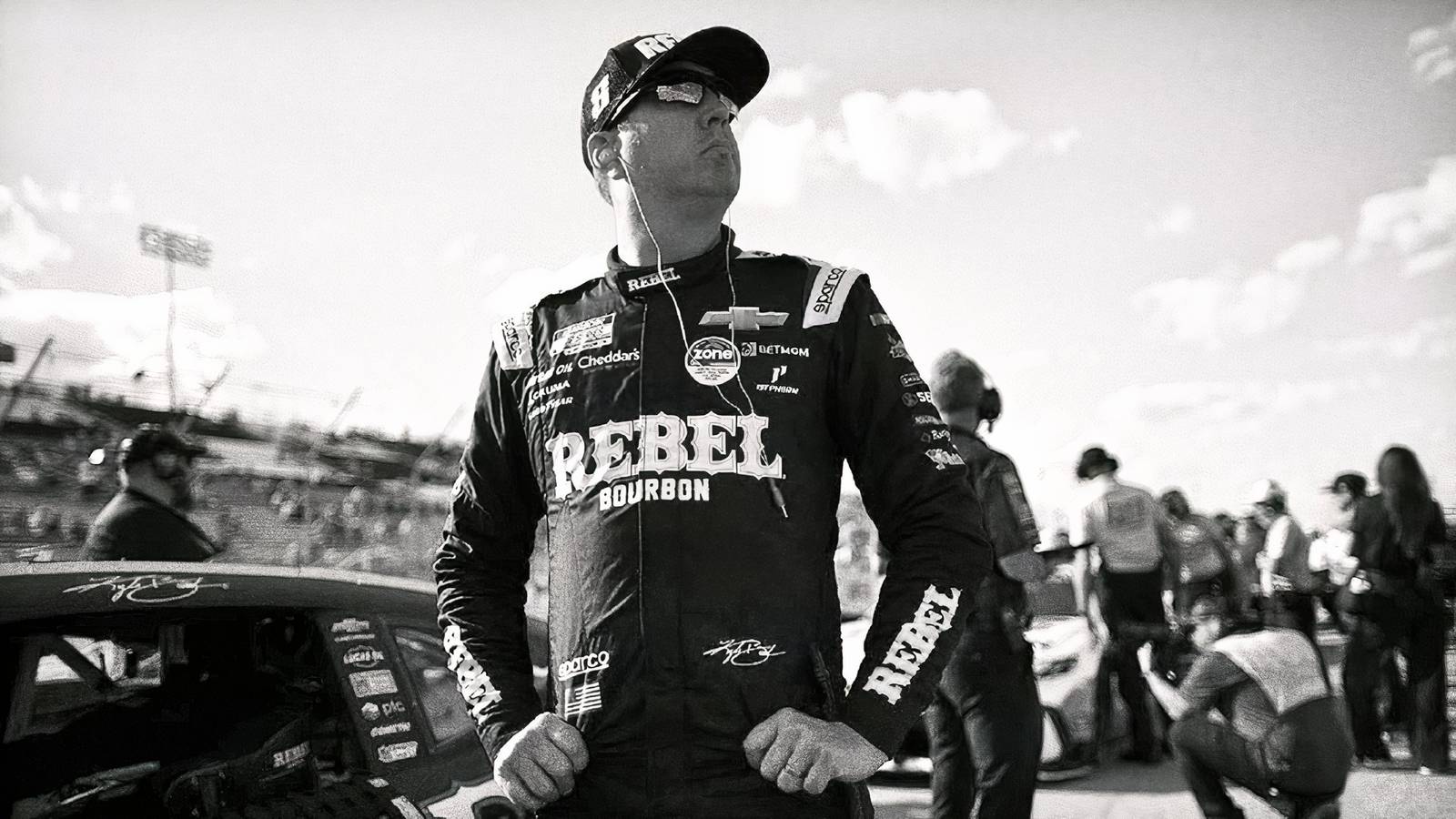
It turns normal moments into evidence, even when those moments were never meant to explain anything.
The reported medical cause gives the story a frame, but it does not remove the emotional mystery of how quickly life can change.
Severe pneumonia progressing to sepsis is a medical explanation, not a satisfying emotional answer.
Fans want the kind of explanation that makes the world feel orderly again, but sudden loss rarely offers that comfort.
It gives facts, dates, emergency calls, hospital reports, and statements, while leaving everyone else to carry the shock.
Busch’s death also created a strange kind of public rereading of his career.
Moments once debated as arrogance, competitiveness, fire, or controversy now sit beside the knowledge that there will be no next chapter for him behind the wheel.
The arguments will not end, because NASCAR fans do not stop debating legends after they are gone.
They will still argue about his greatest win, his most controversial moment, his place among the best, and whether his cross-series dominance can ever be matched.
But the tone changes when the driver is no longer available to answer the next green flag.
The numbers become fixed.
The final interviews become heavier.
The last car number becomes symbolic.
The final weekend becomes a story fans tell each other because they need the loss to have shape.
NASCAR’s public tributes reflected that difficulty, as the sport tried to honor a driver who was both beloved and polarizing.
NASCAR CEO Steve O’Donnell praised Busch’s legacy and personality, describing him in memorable terms while respecting the family’s privacy around health details.
That balance mattered, because the public wanted answers, but the family deserved space during the most private part of a public tragedy.
The official family update about severe pneumonia and sepsis gave fans more clarity than they had in the first wave of reports.
It also reminded people that even athletes who appear strong, active, and competitive can be vulnerable to medical crises that escalate quickly.
That message is one reason the story spread so widely beyond core NASCAR circles.
People who may not have followed every race still understood the shock of a 41-year-old champion dying suddenly after a severe illness.
For NASCAR fans, though, the loss was layered with memory.
They remembered the younger Kyle Busch, fast and brash, winning early and making rivals uncomfortable.
They remembered the Joe Gibbs Racing years, the championships, the boos, the celebrations, and the way he could turn a routine race into a conversation.
They remembered the move to Richard Childress Racing, the new colors, the No. 8, and the attempt to write a final competitive chapter outside the organization where he became a star.
They remembered the Truck wins, the Xfinity dominance, the Cup trophies, and the restless hunger that seemed to follow him into every garage.
Most of all, they remembered that he made NASCAR feel alive in a very specific way.
Not always comfortable.
Not always polite.
But alive.
That is why the question of what happened carries so much weight.
It is not only a medical question.
It is a fan’s attempt to understand how a figure who seemed so forceful could disappear so quickly.
The answer, as reported by his family, is severe pneumonia that progressed into sepsis.
The surrounding details include shortness of breath, coughing up blood, a simulator session, a hospital transport, and a racing community left stunned.
But the larger story is about a sport trying to absorb the loss of someone who had shaped its emotional temperature for years.
The garage at Charlotte did not stop forever, because racing does not know how to stop forever.
But it slowed in all the ways people notice when grief enters a workplace built for speed.
A crew member paused with a wrench in hand.
A journalist lowered a camera.
A fan looked at the No. 33 and thought about the No. 8.
A child’s name, Brexton, became part of the way people talked about legacy, future, and loss.
That is how Kyle Busch’s death moved through NASCAR.
Not as one headline.
As a series of moments that kept widening.
A medical update.
A 911 detail.
A renumbered car.
A reserved number.
A final Truck win.
A garage silence.
A fan base still asking what happened, even after the first answer arrived.
In the end, the cause now reported by his family gives fans the clearest explanation available, but it cannot fully explain the feeling left behind.
Kyle Busch died after severe pneumonia progressed into sepsis, a sudden medical crisis that took one of NASCAR’s most accomplished drivers at just 41.
Richard Childress Racing set aside the No. 8, reserving it for Brexton, and the No. 33 carried the burden of moving forward without pretending anything was normal.
The records will say 63 Cup wins, two Cup championships, 102 second-tier wins, 69 Truck wins, and 234 national-series victories.

Fans will remember more than that.
They will remember the noise he created.
They will remember the arguments.
They will remember the wins.
They will remember the final clips.
They will remember the No. 8 being held back, not erased.
And they will remember that at Charlotte, in a garage made for engines, the loudest thing for a moment was silence.
