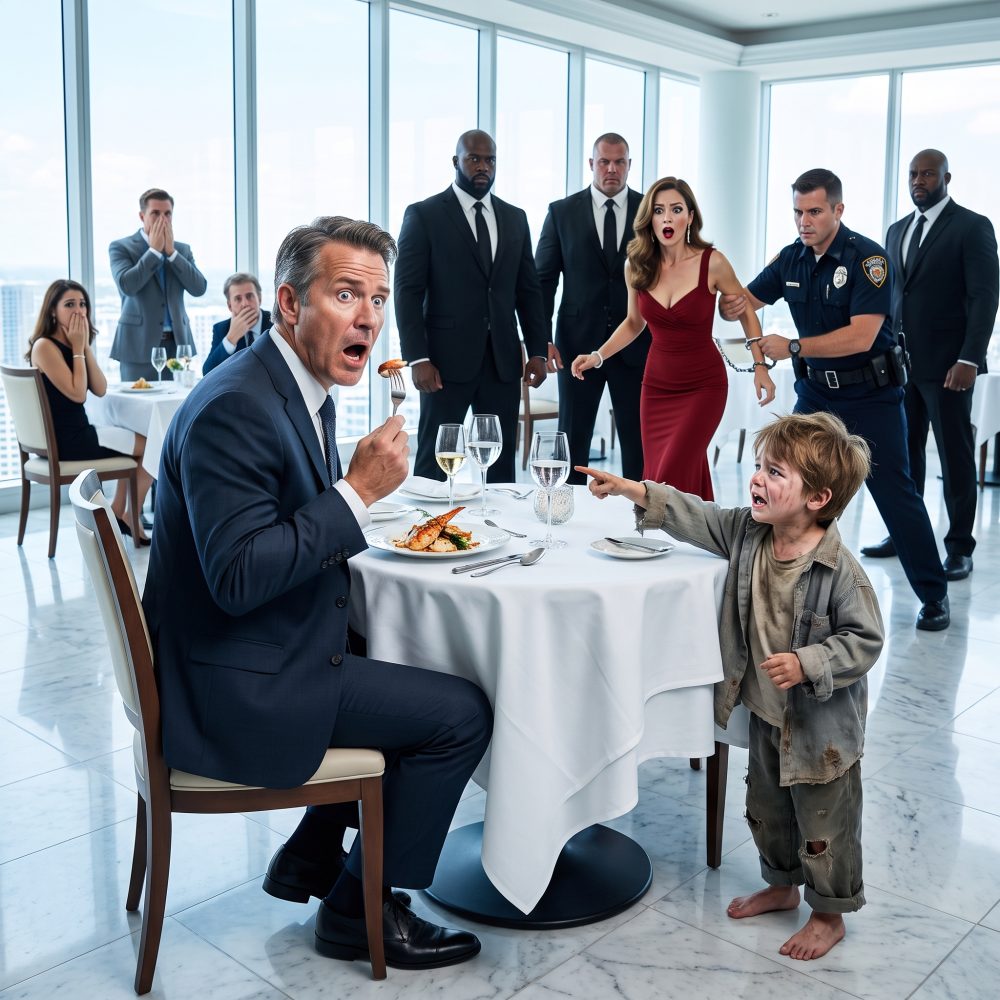
The first warning came from a child no one else in the room wanted to see. I had just lifted a forkful of sea bass when a barefoot boy burst through the glass doors and screamed, “Stop! Don’t eat that!”
Every head in Bellamy’s turned. My two bodyguards moved instantly, one blocking the aisle, the other reaching for the boy’s shoulder. He could not have been more than six. His shirt was torn, his knees were dirty, and fear had hollowed his face.
“Remove him,” my wife, Celeste, said coldly.
The boy twisted free and pointed at her. “She told the waiter to put something in his food!”
Celeste laughed, too quickly. “He’s homeless, Adrian. He probably wants money.”
I lowered my fork.
For three months, Celeste had treated me like a dying man. She had replaced my physician, pressured me to revise my will, and reminded everyone that stress had made me “confused.” At board meetings, she answered questions for me. At home, she hid documents and smiled when I forgot where she had moved them.
What she did not know was that I had forgotten nothing.
At breakfast that morning, she had corrected me in front of the staff, taken my keys, and called me fragile. When I objected, she kissed my cheek and said, “Let the capable people handle things now.” Martin had laughed. I had lowered my eyes, giving them exactly the weakness they expected.
Years earlier, before building Northbridge Hotels into a billion-dollar company, I had worked as a forensic accountant for federal prosecutors. Patterns were my language. Celeste’s sudden affection, the new insurance policy, the private meetings with my chief financial officer, Martin Vale—none of it was invisible to me.
I looked past the boy and saw a waiter near the kitchen. His face had gone gray. Celeste’s hand rested beside her untouched plate.
“Bring the child here,” I said.
My guards hesitated.
“That was not a suggestion.”
The boy approached, trembling. “I saw her give the waiter a little bottle,” he whispered. “She said I could have bread if I stayed quiet.”
Celeste leaned toward me. “Adrian, you’re embarrassing yourself.”
I smiled and switched our plates.
Her eyes widened for half a second.
That half second told me everything.
I did not let her eat. I signaled my head of security, Elias, and he quietly sealed the exits. Then I placed my phone beneath the table and called Detective Mara Quinn, the only person outside my legal team who knew I had been investigating my wife.
“Begin the operation,” I said.
Celeste reached for my wrist. “What operation?”
I looked at the poisoned plate between us.
“The one you just completed for me.”
Part 2
Celeste recovered quickly. Arrogance had always been her strongest anesthetic.
She folded her napkin. “This is absurd. You summoned police because a street child invented a story?”
The boy flinched. I moved him behind Elias.
Within minutes, officers entered without sirens. Detective Quinn arrived in a gray suit, followed by a food-safety investigator carrying evidence bags. The manager locked the kitchen. Phones rose around the dining room, but security ordered everyone to remain seated.
Martin Vale appeared from the bar.
That surprised Celeste more than the police.
“What is he doing here?” I asked.
Martin forced a smile. “Lunch meeting.”
“With my wife?”
Read More
Celeste’s expression sharpened. “Stop performing, Adrian.”
Quinn collected both plates, Celeste’s wineglass, the waiter’s apron, and the bottle found behind a flour bin. The waiter, Luis, collapsed into a chair before anyone questioned him.
“She threatened my daughter,” he blurted. “Mrs. Cross said Martin could have immigration officers take my family. She paid me ten thousand dollars.”
“You liar!” Celeste snapped.
Quinn placed a recorder on the table. “Keep talking, Mrs. Cross.”
Celeste went silent.
The boy’s name was Noah. He slept behind the restaurant with his mother, who had disappeared two nights earlier after entering rehabilitation. Kitchen workers sometimes gave him leftovers. That afternoon, he had crawled beneath a delivery window and overheard Celeste instructing Luis.
He had risked the only kindness available to him to save my life.
I knelt beside him. “You did the right thing.”
“Are you going to die?” he asked.
“No.”
Nearby, Celeste smiled again. She believed the bottle would prove nothing. She believed Martin had erased the transfers and altered medical files. Most of all, she believed my supposed memory problems had left me helpless.
I allowed her that comfort.
Quinn could not arrest her until testing established what was in the food, so Celeste stood and collected her purse.
“This marriage is over,” she announced. “By tonight, I’ll have you declared incompetent.”
Martin stepped beside her. “The board already has the petition.”
I nodded. “Then present it.”
They mistook my calm for surrender.
At Northbridge headquarters two hours later, Celeste entered the board meeting wearing white, as if attending my funeral. Martin displayed reports from Dr. Samuel Pike describing paranoia, cognitive decline, and financial instability. Three directors avoided my eyes. Two accepted Martin’s promises of promotions.
Celeste placed conservatorship papers before me.
“Sign,” she whispered, “and preserve what remains of your dignity.”
I opened the folder, then slid a different document across the table.
It was a federal preservation order covering every company server, account, security camera, and phone belonging to Martin, Celeste, and Dr. Pike.
Martin stopped breathing.
I turned on the wall screen. Bank transfers appeared first. Then hotel footage showed Celeste entering Martin’s suite seventeen times. Audio followed: her voice discussing my dosage, my will, and the division of Northbridge after my death.
Celeste stared at me.
“You recorded us?”
“No,” I said. “You targeted the owner of twenty-seven hotels and held your conspiracy inside them.”
Part 3
The laboratory result arrived while the recording was still playing.
Detective Quinn entered the boardroom with agents. “The substance recovered from Mr. Cross’s meal was aconitine,” she said. “In that concentration, death could have occurred within an hour.”
Celeste’s face emptied.
Quinn continued. “We recovered your fingerprints from the bottle and messages ordering Mr. Vale to purchase it overseas.”
Martin backed toward the door. Elias blocked him.
“This was her plan,” Martin said. “She manipulated me.”
Celeste struck him. “Coward!”
I remained seated.
They expected rage, panic, or pleading. Calm frightened them because it meant preparation.
I revealed the final piece. Dr. Pike had never examined me alone. I hired an independent neurologist and wore a recording device during appointments. Pike had coached me to report symptoms I did not have, increased medication known to cause disorientation, and emailed Celeste instructions for making my decline appear credible.
The agents arrested Martin for conspiracy, wire fraud, and attempted murder. Pike was taken from his clinic that evening. Four compromised directors were removed after an investigation exposed kickbacks and secret stock agreements.
Celeste watched the handcuffs close around her wrists.
“You think you’ve won?” she hissed. “Without me, you’ll die alone.”
I looked toward Noah, who stood beside Quinn with a hot meal in his hands.
“No,” I said. “Without you, I finally get to live.”
The criminal trial lasted nine weeks. Luis testified under immunity and entered witness protection with his daughter. Security footage, financial records, pharmacy purchases, and Celeste’s messages formed a chain her lawyers could not break. Martin pleaded guilty and testified against her, but the judge sentenced him to twenty-two years. Dr. Pike lost his medical license and received twelve years.
Celeste refused every deal.
The jury convicted her on every count. She received thirty-five years without parole eligibility until old age. Our prenuptial agreement stripped her of claims connected to criminal misconduct, and the civil court awarded her assets to those harmed by the scheme.
I used that money to establish the Noah Grant, funding housing and legal support for homeless families. Noah’s mother completed treatment, and I helped reunite them in an apartment near a public garden. I never tried to replace his family. I made sure poverty could not punish him for saving me.
One year later, Noah joined me at Bellamy’s for lunch. He wore sneakers but kicked them off beneath the table because he said food tasted better barefoot.
The restaurant had changed its policies. Leftover meals now went to shelters, and workers received protection for reporting coercion.
Noah studied my plate. “Is it safe?”
I took the first bite and smiled warmly. “Perfectly safe.”
Outside, sunlight flashed across the city I had nearly lost. Northbridge was thriving under new leadership, my health had returned, and my home was quiet.
Celeste had wanted my fortune, my name, and my life.
She lost her freedom.
I gained something wealth had never purchased: certainty that courage can enter through any door, even barefoot, and change the ending.