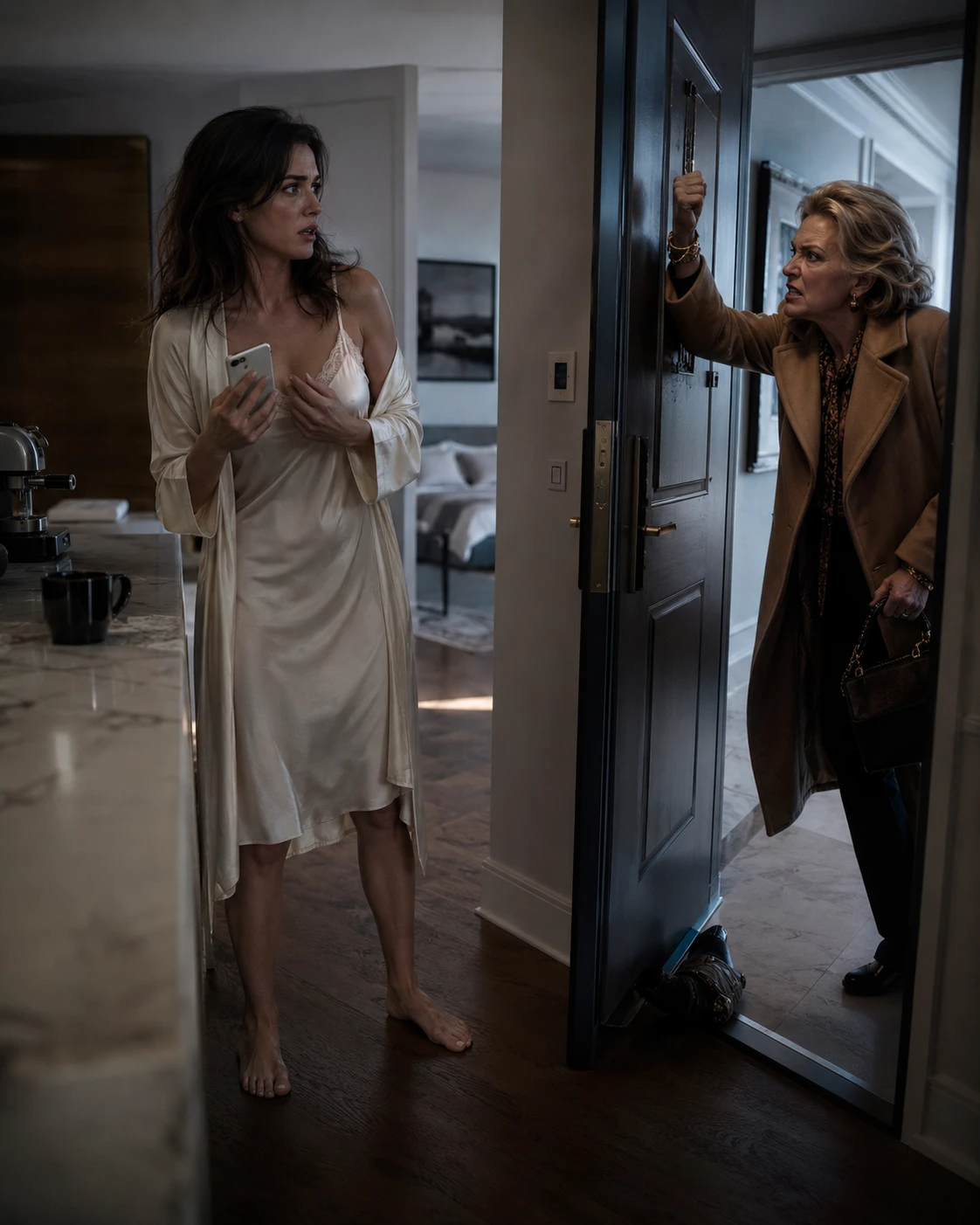
The scraping sound came again, slow and ugly, like metal being dragged across the lock plate.
I stood barefoot in my bedroom doorway, phone in my hand, listening to Eleanor breathe through my apartment door.
For five years, that woman had entered every room like ownership was something stitched into her expensive coats.
Now she was outside my home at dawn, screaming because the money had finally stopped obeying her.
“Open the door, Marissa,” she shouted, her voice cracking against the hallway walls. “You owe me an explanation.”
I almost laughed, because people like Eleanor always called consequences explanations they were entitled to receive privately.
Instead, I pressed record on my phone and walked quietly toward the entryway.
Through the peephole, I saw her standing there in a cream wool coat, lipstick perfect, eyes wild.
Beside her stood Anthony, hair uncombed, jaw tight, one hand pressed against the doorframe.
Behind them, half-hidden near the elevator, stood the building’s night doorman, terrified and helpless.
Eleanor lifted a heavy brass umbrella stand and slammed it against my door hard enough to shake the hinges.
That was the scraping sound I had heard from my bedroom.
She was not knocking anymore.
She was trying to break in.
I dialed 911 with one thumb while keeping the camera aimed through the peephole.
“My ex-mother-in-law is attempting to force entry into my apartment,” I told the dispatcher, keeping my voice steady.
Anthony must have heard me through the door, because his expression shifted from rage into sudden calculation.
“Marissa,” he called, softer now, almost pleading. “Come on, don’t make this uglier than it already is.”
That old tone slid under the door like smoke, familiar and poisonous.
It was the voice he used before convincing me to apologize for things his mother had done.
It was the voice he used when Eleanor insulted my career, my clothes, my parents, and my body.
It was the voice that had once made cruelty feel like something I needed to manage politely.
But divorce had changed the locks inside me before it changed the ones on my door.
“You need to leave,” I said loudly. “Both of you are being recorded, and police are on the way.”
Eleanor shrieked something so sharp that a neighbor’s door opened two inches down the hall.
“You ungrateful little climber,” she screamed. “You married into this family with nothing, and now you think you can punish me.”
Anthony grabbed her arm, but not because he cared about my safety.
He grabbed her because witnesses had appeared.
That had always been the real boundary for his family.
Not decency.
Not legality.
Only witnesses.
“You were removed from my credit card because the divorce is final,” I said through the door.
Eleanor laughed once, loud and shaking, as though reality itself had offended her.
“That card paid for family expenses,” she snapped. “You do not get to humiliate me because your marriage failed.”
“My marriage failed because your son loved your comfort more than my peace,” I answered.
The hallway went silent for one breathtaking second.
Then Eleanor hit the door again.
This time, the top chain trembled.
I stepped back, fear finally burning through my calm.
At that exact moment, another sound cut through the hallway.
The elevator bell.
Two uniformed police officers stepped out, followed by Mr. Alvarez, my building manager, wearing slippers and a winter coat.
Anthony released Eleanor’s arm instantly and arranged his face into wounded respectability.
“Officers,” he said smoothly, turning with both hands visible. “This is a family misunderstanding.”
I opened the door only after the officers stood between them and me.
The brass umbrella stand lay on the carpet, dented, guilty, and impossible to explain away.
My doorframe had fresh marks along the lock, deep enough to make one officer raise his eyebrows.
Eleanor immediately pointed at me as though arriving first made her the victim.
“She stole my card,” Eleanor said. “She canceled my account and left me humiliated in a public place.”
The younger officer looked at her, then looked at me in my robe and bare feet.
“Ma’am,” he said carefully, “whose name was on the account?”
Eleanor’s mouth opened, but no answer came.
Anthony stepped in quickly, still trying to control the performance.
“It was my ex-wife’s account,” he said. “But my mother was an authorized user during the marriage.”
“And the divorce was finalized yesterday,” I said, handing over my phone with the recording still open.
The officers watched the video in the hallway while Eleanor’s face hardened with every second.
Her screaming filled the small space again, now trapped inside evidence instead of emotion.
Mr. Alvarez crossed his arms and looked at Anthony with the disgust of a man remembering every ignored complaint.
“This is not the first time your family caused trouble here,” he said quietly.
Anthony shot him a look, but the room no longer belonged to Anthony’s version of events.
The older officer asked whether I wanted to press charges for attempted forced entry and harassment.
Eleanor gasped as though the law had insulted her personally.
Anthony’s face changed again, and this time I saw real fear behind the polished anger.
“Marissa,” he said, lowering his voice, “think carefully before you start a war you cannot afford.”
The officer looked at him immediately.
“That sounded like a threat,” he said.
Anthony lifted both hands and smiled thinly, but the damage had already escaped his mouth.
I felt something inside me settle into place, clean and final.
For years, I had measured my safety by how little I angered them.
Now the police were standing in my hallway, and Anthony was still acting like fear belonged only to me.
“I want the report filed,” I said.
Eleanor stared at me as if I had slapped her.
“You vindictive nobody,” she whispered.
The older officer stepped closer to her.
“Ma’am, you need to stop talking now.”
Those seven words seemed to wound Eleanor more deeply than losing the card.
She had spent her life confusing money with immunity, and this hallway refused to bow.
The officers escorted them downstairs after taking statements, leaving me with a damaged door and shaking knees.
Mr. Alvarez stayed behind, inspecting the frame with the seriousness of a man protecting his building.
“I will have maintenance reinforce this today,” he said. “And I am removing their visitor approval from the system.”
I thanked him, and my voice broke on the final word.
He pretended not to notice, which was the kindest thing anyone had done that morning.
When I closed the door, the apartment felt different.
Not safe exactly.
But mine.
I leaned against the wall and slid down until the cold floor pressed against my legs.
The sun had risen fully now, spilling thin gold light across the living room rug.
My phone buzzed before I could breathe evenly again.
Unknown number.
Then another.
Then a text.
“You have no idea what my family can do to you,” Anthony wrote.
I stared at the message until my fear changed shape.
It became evidence.
By nine o’clock, I had sent everything to my divorce attorney, Rebecca Sloan.
The video.
The police report number.
The text.
Photos of the damaged door.
Rebecca called me twelve minutes later, and her voice carried the calm fury only excellent attorneys possess.
“Marissa,” she said, “do not respond to him again under any circumstances.”
“I wasn’t planning to,” I said.
“Good,” she replied. “Because he just handed us something useful.”
By noon, Rebecca had filed an emergency motion enforcing financial separation and requesting a protective order.
By two, the building security office had delivered hallway footage showing Eleanor arriving with the brass umbrella stand.
By four, Anthony’s attorney called Rebecca twice, suddenly interested in resolving matters privately.
That was when I understood the rhythm of powerful families.
They attacked loudly when they believed nobody was watching.
They begged quietly when evidence learned their names.
The next morning, I went to work wearing a navy dress, low heels, and concealer under my tired eyes.
I was a senior financial analyst at a private investment firm, a fact Eleanor had mocked whenever bills arrived conveniently paid.
She called my job “spreadsheet work,” as if money only mattered when someone else was spending it.
I had spent years making men richer while pretending not to notice I was funding my own humiliation.
At 10:17, my assistant knocked softly and said Anthony was waiting downstairs.
I looked up from a quarterly risk model and felt absolutely nothing.
Not panic.
Not longing.
Not even surprise.
“Tell security he is not permitted upstairs,” I said.
Five minutes later, Rebecca called.
“He is outside your office because his mother’s attorney informed him about the protective order hearing,” she said.
I closed my laptop carefully.
“His mother has an attorney?”
“Apparently,” Rebecca said. “And apparently they believe you defamed her by stating she was financially dependent on you.”
I laughed then, one short sound that startled my assistant through the glass wall.
“She was financially dependent on me,” I said.
“I know,” Rebecca replied. “That is why I want your spreadsheet.”
For five years, the spreadsheet had been my private shame.
Rows of charges.
Dates, vendors, amounts, notes.
Eleanor’s $1,200 facials.
Eleanor’s $800 lunches.
Eleanor’s $6,400 handbag purchased the week Anthony said we could not afford couples therapy.
I had made the file because numbers were easier to face than grief.
Now the same numbers were going to speak for me.
Two days later, I sat in a small courtroom while Eleanor wore black cashmere and performed wounded dignity.
Anthony sat beside her, jaw clenched, refusing to look directly at me.
Rebecca placed the spreadsheet on the table with the gentleness of a woman laying a blade down.
The judge reviewed the charges in silence for almost three minutes.
Eleanor’s attorney tried to argue that the spending had been part of an accepted family arrangement.
Rebecca asked whether that arrangement survived the divorce decree signed the previous morning.
The courtroom went wonderfully quiet.
Then she played the hallway recording.
Eleanor’s voice filled the room, shrieking threats about humiliation, money, and what I owed her.
The judge removed her glasses slowly.
That small movement frightened Eleanor more than any shouted accusation could have.
“Mrs. Hayes,” the judge said, “you appear to misunderstand the difference between embarrassment and injury.”
Eleanor sat perfectly still, her hands clasped around a designer handbag I had probably paid for.
The judge granted the protective order, ordered no contact, and required Anthony to communicate only through counsel.
She also noted that any further attempt to access my financial accounts would be referred for investigation.
Anthony followed me with his eyes as I left the courtroom.
For once, he looked less angry than abandoned.
Outside, in the marble hallway, he broke the order within seven minutes.
“Marissa,” he called, stepping away from his lawyer. “Please, just listen for one second.”
Rebecca turned so sharply that even Anthony stopped moving.
“Mr. Hayes,” she said, “you are already making poor choices in front of witnesses.”
He ignored her and looked at me.
“My mother is impossible,” he said, voice low and ragged. “You know that better than anyone.”
I did not answer.
“She is threatening to cut me out of everything if I do not fix this,” he continued.
That was almost funny, because Eleanor’s power had always depended on somebody else paying.
“She says you ruined her reputation,” he said.
I looked at him then, really looked at the man I had once loved.
Anthony was not cruel in the loud way Eleanor was cruel.
He was worse.
He was the man who watched cruelty happen and handed it better lighting.
“No,” I said. “I stopped financing the reputation she already ruined herself.”
His eyes flickered, and for a second I saw the boy he must have been before Eleanor raised him into cowardice.
Then the moment passed, and he became Anthony again.
“You could have warned us,” he said.
I nodded once, almost kindly.
“I did,” I replied. “Every month I looked miserable while paying for your mother, and you chose not to notice.”
Rebecca touched my elbow, and we walked away before he could turn guilt into another argument.
That evening, I returned home to a reinforced door and a quiet apartment smelling faintly of fresh paint.
On the counter sat the espresso mug from the morning everything changed.
I washed it slowly, dried it carefully, and placed it in the cabinet beside one single wineglass.
Not two.
One.
For the first time, that did not feel lonely.
It felt accurate.
Weeks passed, and silence grew around me like a room finally cleared of smoke.
Eleanor’s card was gone.
Anthony’s messages stopped.
The legal letters became fewer, colder, and less confident.
Then one Friday afternoon, Rebecca forwarded me a document from Anthony’s attorney.
It was a proposed settlement adjustment.
Anthony wanted to avoid further public filings connected to Eleanor’s spending.
In exchange, he offered to reimburse every charge his mother had made during the final year of our marriage.
I opened the spreadsheet and stared at the final total.
Seventy-eight thousand, four hundred and twelve dollars.
For a long time, I simply sat there, not because the amount shocked me.
I had known the number.
I had lived beneath it.
What shocked me was realizing I no longer wanted him to hurt.
I only wanted him gone.
I accepted the reimbursement with one added condition.
Every dollar would be paid through counsel, and neither Anthony nor Eleanor would contact me again.
Three months later, the money arrived.
I did not buy jewelry.
I did not book a spiteful vacation.
I paid off the last shared debt Anthony had convinced me was mine.
Then I changed my locks again, replaced my mattress, and bought a small painting from a street artist in SoHo.
It showed a woman standing before a closed door with morning light behind her.
No face.
No title.
Just a figure choosing not to open what had already tried to destroy her.
I hung it in the hallway where Eleanor’s screams had once entered my home.
Sometimes guests asked what it meant.
I always smiled and said it was about boundaries.
A year later, I saw Anthony by accident outside a restaurant near Madison Avenue.
He looked thinner, older, and less polished than I remembered.
Beside him, Eleanor argued with a waiter about a table near the window.
For one strange second, I felt the old reflex return.
Smooth it over.
Apologize.
Pay.
Disappear.
Then Anthony looked up and saw me.
His expression shifted through shock, shame, and something almost like longing.
Eleanor turned too, and her mouth tightened when she recognized me.
I waited for fear.
It never came.
Anthony took one step forward, then stopped, remembering court orders, consequences, and perhaps himself.
Eleanor looked at my handbag, my coat, my face, searching for some visible sign that she had ruined me.
She found none.
I walked past them into the restaurant where my friends were waiting, laughing beneath warm lights.
Behind me, Eleanor’s voice rose again, sharp and demanding, but it no longer entered my body.
Some wars end not when the enemy apologizes.
Some wars end when their noise becomes background sound.
I had canceled a credit card because the divorce was final.
But what I really canceled was my subscription to humiliation.
I canceled the monthly payment on peace that was never delivered.
I canceled the family role where silence was mistaken for permission.
Eleanor had come to my door believing rage could reopen the account.
Anthony had stood beside her believing guilt could restore the leash.
They both learned that morning that freedom has paperwork, witnesses, passwords, locks, and receipts.
Most importantly, they learned that the woman who paid quietly was never weak.
She was only waiting for the day the balance finally came due.